Michael Justin Kearns is an American computer scientist, professor and National Center Chair at the University of Pennsylvania, the founding director of Penn's Singh Program in Networked & Social Systems Engineering (NETS), the founding director of Warren Center for Network and Data Sciences, and also holds secondary appointments in Penn's Wharton School and department of Economics. He is a leading researcher in computational learning theory and algorithmic game theory, and interested in machine learning, artificial intelligence, computational finance, algorithmic trading, computational social science and social networks. He previously led the Advisory and Research function in Morgan Stanley's Artificial Intelligence Center of Excellence team, and is currently an Amazon Scholar within Amazon Web Services. == Biography == Kearns was born into an academic family, where his father David R Kearns is Professor Emeritus at University of California, San Diego in chemistry, who won Guggenheim Fellowship in 1969, and his uncle Thomas R. Kearns is Professor Emeritus at Amherst College in Philosophy and Law, Jurisprudence, and Social Thought. His paternal grandfather Clyde W. Kearns was a pioneer in insecticide toxicology and was a professor at University of Illinois at Urbana–Champaign in Entomology, and his maternal grandfather Chen Shou-Yi (1899–1978) was a professor at Pomona College in history and literature, who was born in Canton (Guangzhou, China) into a family noted for their scholarship and educational leadership. Kearns received his B.S. degree at the University of California at Berkeley in math and computer science in 1985, and Ph.D. in computer science from Harvard University in 1989, under the supervision of Turing Award winner Leslie Valiant. His doctoral dissertation was The Computational Complexity of Machine Learning, later published by MIT press as part of the ACM Doctoral Dissertation Award Series in 1990. Before joining AT&T Bell Labs in 1991, he continued with postdoctoral positions at the Laboratory for Computer Science at MIT hosted by Ronald Rivest, and at the International Computer Science Institute (ICSI) in UC Berkeley hosted by Richard M. Karp, both of whom are Turing Award winners. Kearns is currently a full professor and National Center Chair at the University of Pennsylvania, where his appointment is split across the Department of Computer and Information Science, and Statistics and Operations and Information Management in the Wharton School. Prior to joining the Penn faculty in 2002, he spent a decade (1991–2001) in AT&T Labs and Bell Labs, including as head of the AI department with colleagues including Michael L. Littman, David A. McAllester, and Richard S. Sutton; Secure Systems Research department; and Machine Learning department with members such as Michael Collins and the leader Fernando Pereira. Other AT&T Labs colleagues in Algorithms and Theoretical Computer Science included Yoav Freund, Ronald Graham, Mehryar Mohri, Robert Schapire, and Peter Shor, as well as Sebastian Seung, Yann LeCun, Corinna Cortes, and Vladimir Vapnik (the V in VC dimension). Kearns was named Fellow of the Association for Computing Machinery (2014) for contributions to machine learning, and a fellow of the American Academy of Arts and Sciences (2012). His former graduate students and postdoctoral visitors include Ryan W. Porter, John Langford, and Jennifer Wortman Vaughan. Kearns' work has been reported by media, such as MIT Technology Review (2014) Can a Website Help You Decide to Have a Kid?, Bloomberg News (2014) Schneiderman (and Einstein) Pressure High-Speed Trading and NPR audio (2012) Online Education Grows Up, And For Now, It's Free. == Academic life == === Computational learning theory === Kearns and Umesh Vazirani published An introduction to computational learning theory, which has been a standard text on computational learning theory since it was published in 1994. === Weak learnability and the origin of Boosting algorithms === The question "is weakly learnability equivalent to strong learnability?" posed by Kearns and Valiant (Unpublished manuscript 1988, ACM Symposium on Theory of Computing 1989) is the origin of boosting machine learning algorithms, which got a positive answer by Robert Schapire (1990, proof by construction, not practical) and Yoav Freund (1993, by voting, not practical) and then they developed the practical AdaBoost (European Conference on Computational Learning Theory 1995, Journal of Computer and System Sciences 1997), an adaptive boosting algorithm that won the prestigious Gödel Prize (2003). == Honors and awards == 2021. Member of the U. S. National Academy of Sciences. 2014. ACM Fellow. For contributions to machine learning, artificial intelligence, and algorithmic game theory and computational social science. 2012. American Academy of Arts and Sciences Fellow. == Selected works == 2019. The Ethical Algorithm: The Science of Socially Aware Algorithm Design. (with Aaron Roth). Oxford University Press. 1994. An introduction to computational learning theory. (with Umesh Vazirani). MIT press. Widely used as a text book in computational learning theory courses. 1990. The computational complexity of machine learning. MIT press. Based on his 1989 doctoral dissertation; ACM Doctoral Dissertation Award Series in 1990 Archived 2014-11-03 at the Wayback Machine 1989. Cryptographic limitations on learning Boolean formulae and finite automata. (with Leslie Valiant) Proceedings of the twenty-first annual ACM symposium on Theory of computing (STOC'89). The open question: is weakly learnability equivalent to strong learnability?; The origin of boosting algorithms; Important publication in machine learning.
Common Image Generator Interface
The Common Image Generator Interface (CIGI) (pronounced sig-ee), is an on-the-wire data protocol that allows communication between an Image Generator and its host simulation. The interface is designed to promote a standard way for a host device to communicate with an image generator (IG) within the industry. CIGI enables plug-and-play by standard-compliant image generator vendors and reduces integration costs when upgrading visual systems. == Background == Most high-end simulators do not have everything running on a single machine the way popular home software flight simulators are currently implemented. The airplane model is run on one machine, normally referred to as the host, and the out the window visuals or scene graph program is run on another, usually referred to as an Image Generator (IG). Frequently there are multiple IGs required to display the surrounding environment created by a host. CIGI is the interface between the 'host' and the IGs. The main goal of CIGI is to capitalize on previous investments through the use of a common interface. CIGI is designed to assist suppliers and integrators of IG systems with ease of integration, code reuse, and overall cost reduction. In the past most image generators provided their own proprietary interface; every host had to implement that interface making changing image generators a costly ordeal. CIGI was created to standardize the interface between the host and the image generator so that little modification would be needed to switch image generators. The CIGI initiative was largely spearheaded by The Boeing Company during the early 21st century. The latest version of CIGI (CIGI 4.0) was developed by the Simulation Interoperability Standards Organization (SISO) in the form of SISO-STD-013-2014, Standard for Common Image Generator Interface (CIGI), Version 4.0, dated 22 August 2014. SISO-STD-013-2014 is freely available from SISO. == Definitions == Image generator – In this context an image generator consists of one or more rendering channels that produce an image that can be used to visualize an “Out-The-Window” scene, or images produced by various sensor simulations such as Infra-red, Day TV, electro-optical, and night vision. Host simulation – In this context a “Host” is the computational system that provides information about the device being simulated so that the image generator can portray the correct scenery to the user. This information is passed via CIGI to the image generator. == Maturation == CIGI 4 is the latest version of the standard as was approved by the Simulation Interoperability Standards Organization on August 22, 2014. CIGI became an international SISO standard known as SISO-STD-013-2014; which contains the CIGI version 4.0 Interface Control Document (ICD). CIGI 4.0 is the official standard, published by SISO. Previous versions of CIGI were spearheaded by Boeing include CIGI v3.3, in November 2008, v3.2 April 2006, v3.1 June 2004, v3 November 2003, v2 in March 2002, and the original (v1) in March 2001 == Protocol dependencies == Typically, CIGI uses UDP as its transport protocol, but CIGI does not require a specific transport mechanism, only packet definition conformance. CIGI traffic does not have a well known port; however, the use of ports 8004-8005 has been widely adopted by commercial image generator vendors implementations. == Development tools == === Host Emulator === The Host Emulator can be used as a surrogate to manipulate the interface when a simulation Host is not available. It is a Windows-based image generator Host application used to develop, integrate and test image generators that use the CIGI protocol. It provides a graphical user interface (GUI) for the creation, modification and deletion of entities; manipulation of views; control of environmental attributes and phenomena; and other host functions. The Host Emulator has several features that are useful for integration and testing. A free-flight mode allows for fixed-wing and rotorcraft flight, movement along entity axes and free rotation using a joystick or a joystick-like widget. Scripting and record/playback features support regression testing, demonstrations and other tasks needing exact reproduction of certain sequences of events. A packet-level snoop feature allows the user to examine the contents of CIGI messages, image generator response times and latencies. A Heartbeat Monitor Window shows a graphical timing history of the Image Generator's data frame rate. Other features include explicit packet creation, animation control, missile flyouts and a situation display window (Host Emulator 3.x only). === Multi-Purpose Viewer === The Multi-Purpose Viewer (MPV) provides the basic functionality expected of an Image Generator, such as loading and displaying a terrain database, displaying entities and so forth. The Multi-Purpose Viewer can be used as a surrogate to manipulate the interface when a real Image Generator is not available. The MPV is capable of operating with both the Windows and Linux operating systems. === CIGI Class Library === The CCL is an object-oriented software interface that automatically handles message composition and decomposition (i.e. packing, unpacking and byte swapping to the ICD specification) on both the Host and Image Generator sides of the interface. The CCL interprets Host or Image Generator messages based on compile time parameters. It also performs error handling and translation between different versions of CIGI. Each packet type has its own class. The individual packet members are accessed through packet class accessors. Outgoing messages are constructed by placing each packet into the outgoing buffer using a streaming operator. Incoming messages are parsed using callback or event-based mechanisms that supply the using program with fully populated packet objects. === Current tool suite === A set of CIGI development tools are managed and maintained by the SISO CIGI Product Support Group. The latest packages are available on SourceForge. Comments/Suggestions to the package can be directed to the SISO discussion board at: https://discussions.sisostds.org/index.htm?A0=SAC-PSG-CIGI Archived 2017-09-13 at the Wayback Machine === Wireshark === Wireshark is a free and open source packet analyzer. It is used for network troubleshooting, analysis, software and communications protocol development, and education. Wireshark provides a dissector for CIGI packets. As of October 2016, “The CIGI dissector is fully functional for CIGI version 2 and 3. Version 1 is not yet implemented.” === Older versions of CIGI === A CIGI Interface Control Document (ICD) and development suite is available in open source format. The tools, ICD, and accompanying user documentation can be found and downloaded from the CIGI sourceforge web site. The SourceForge version of the MPV is limited in its support of CIGI data packets and is intended to grow as needs arise. The MPV uses CIGI 3 as its interface, but the MPV is backward-compatible with earlier CIGI versions through the use of the CCL. The MPV uses the Open Scene Graph library to render a scene. The scene graph is manipulated according to the CIGI commands received from the Host via the CCL. The MPV itself is an application layer that consists of a small kernel leveraging heavily on a plug-in architecture for ease of maintainability and flexibility. An implementer can implement the interface from scratch, however a full suite of integration tools is available. These tools consist of three elements. The Host Emulator (HE), the Multi-Purpose Viewer (MPV), and the CIGI Class Library (CCL).
Machine unlearning
Machine unlearning is a branch of machine learning focused on removing specific undesired element, such as private data, wrong or manipulated training data, outdated information, copyrighted material, harmful content, dangerous abilities, or misinformation, without needing to rebuild models from the ground up. Large language models, like the ones powering ChatGPT, may be asked not just to remove specific elements but also to unlearn a "concept," "fact," or "knowledge," which aren't easily linked to specific examples. New terms such as "model editing," "concept editing," and "knowledge unlearning" have emerged to describe this process. == History == Early research efforts were largely motivated by Article 17 of the GDPR, the European Union's privacy regulation commonly known as the "right to be forgotten" (RTBF), introduced in 2014. The GDPR did not anticipate that the development of large language models would make data erasure a complex task. This issue has since led to research on "machine unlearning," with a growing focus on removing copyrighted material, harmful content, dangerous capabilities, and misinformation. Just as early experiences in humans shape later ones, some concepts are more fundamental and harder to unlearn. A piece of knowledge may be so deeply embedded in the model's knowledge graph that unlearning it could cause internal contradictions, requiring adjustments to other parts of the graph to resolve them. Researchers have now also started studying unlearning in the context of removing incorrect or adversarially manipulated training data such as systematically biased labels or poisoning attacks. == Motivations == At present, machine unlearning is motivated by a growing range of concerns that extend well beyond the field's original focus on data privacy. A widely used taxonomy in the literature distinguishes two high-level categories of motivation. Access revocation covers cases where a data subject or rights holder requests the removal of data they own or control. This is most commonly associated with RTBF established by the European Union's General Data Protection Regulation (GDPR) and analogous legislation such as the California Consumer Privacy Act (CCPA). These regulations grant individuals the legal right to request erasure of their personal data from any system that has processed it, including models that were trained on it. Access revocation also encompasses the removal of copyrighted or pay-walled content that was incorporated into training corpora without the necessary licenses, a concern that has become prominent with the widespread use of largely web-scraped pre-training datasets. Model correction covers cases where the model exhibits undesirable behavior arising from the training data, regardless of any individual's request. This includes: Removal of toxic, biased, or unsafe outputs introduced by harmful content in the training set Correction of stale or factually incorrect associations, such as outdated knowledge encoded in a deployed model Removal of dangerous capabilities, such as detailed knowledge of the synthesis of chemical or biological agents Correction of the influence of data poisoning or adversarial attacks that have corrupted model behavior This second category has been formalized as corrective machine unlearning, which frames unlearning as a post-training mechanism for repairing the effects of bad or harmful training data. It is closely related to the AI safety literature, where data filtering alone has been found insufficient to prevent hazardous knowledge from being encoded in model weights, motivating unlearning as a complementary risk mitigation strategy. A further distinction has been drawn in the literature between removal {eliminating the influence of specific training data on model parameters) and suppression (preventing the model from generating specific outputs regardless of how that knowledge is encoded). These two goals are not equivalent: removing training data does not guarantee meaningful output suppression, and suppressing outputs does not constitute removal of the underlying training data's influence. == SISA Training == SISA is a training strategy consisting of four mechanisms designed to make machine unlearning more efficient by structuring how models are trained and updated. Its goal is to allow a system to remove the influence of specific data points without retraining an entire model from scratch. By reorganizing training data and workflows, SISA reduces the computational burden of unlearning requests. Sharding divides the training dataset into multiple disjoint subsets, or shards. Each shard is used to train a separate model instance. This ensures that a single data point affects only one shard, so unlearning it requires updating only the corresponding shard rather than the full model. Isolation refers to training each shard independently, with nothing shared across shards during the training process. This separation prevents cross-contamination between shards, ensuring that forgetting data in one shard does not require adjustments to any others. Slicing breaks the data within each shard into sequential slices and stores model states after each slice is trained on. When an unlearning request targets a piece of data, the system can roll back to the checkpoint before the point was seen and retrain only from that slice forward. This reduces retraining time even within a shard. Aggregation occurs at inference, when the model is queried. It combines the outputs of each shard to determine the output of the overall model. This is often through majority voting or averaging. This allows SISA-trained systems to behave like a single model despite being composed of multiple shard-level models. Together, these mechanisms enable machine learning systems to forget specific data points with far lower computational cost than full retraining. The trade-off is that sharding and slicing can lead to reduced model accuracy, worse generalization, and increased storage requirements for the intermediate checkpoints. This can be tolerable based on the needs of the individual or organization to comply with "right to be forgotten" or efficiently recover from backdoor attacks. == Algorithms == Machine unlearning algorithms are broadly categorized into exact and approximate methods, reflecting a fundamental trade-off between formal guarantees and computational tractability. === Exact Unlearning === Exact unlearning methods produce a model that is statistically indistinguishable from one retrained from scratch on the dataset with the forget data removed. The canonical framework for exact unlearning is SISA Training (Sharded, Isolated, Sliced, and Aggregated), introduced by Bourtoule et al. (2021). SISA partitions the training dataset into disjoint shards and trains a separate sub-model on each. At inference time, predictions are aggregated across sub-models. When an unlearning request is received, only the sub-model corresponding to the shard containing the target data requires retraining, reducing computational overhead proportionally to the number of shards. Exact methods provide the strongest guarantees but become prohibitively expensive for large pre-trained neural networks and are generally limited to settings where training can be structured in advance. === Approximate Unlearning === Approximate unlearning methods seek to produce a model whose behavior is sufficiently close to an exactly unlearned model without the cost of full retraining. These methods dominate practical applications. Common approaches include: Gradient Ascent: The model is fine-tuned by maximizing the loss on the forget set, directly degrading its performance on targeted data. This is the most direct approach but risks destabilizing performance on retained data. Random Labelling: The model is fine-tuned on the forget set using randomly shuffled labels, confusing its associations with the targeted data while producing a less aggressive weight shift than pure gradient ascent. Gradient Difference: Combines gradient ascent on the forget set with simultaneous gradient descent on the retain set, using the retain objective as a regularizer to preserve general model utility. KL Divergence Regularization: Minimizes the KL divergence between the outputs of the unlearned model and the original model on the retain set, anchoring behavior on data the model should remember. Weight Pruning and Fine-tuning: Parameters with the smallest L1-norm are pruned — targeting weights most weakly associated with general knowledge and potentially most associated with the forget set — followed by fine-tuning on the retain set to restore utility. Layer Reset and Fine-tuning: The first or last k layers are re-initialized to random weights and the model is subsequently fine-tuned on the retain set. This is a coarse but computationally simple approach. Selective Synaptic Dampening: Uses influence functions to estimate the effect of individual trainin
Bag-of-words model
The bag-of-words (BoW) model is a model of text which uses an unordered collection (a "bag") of words. It is used in natural language processing and information retrieval (IR). It disregards word order (and thus most of syntax or grammar) but captures multiplicity. The bag-of-words model is commonly used in methods of document classification where, for example, the (frequency of) occurrence of each word is used as a feature for training a classifier. It has also been used for computer vision. An early reference to "bag of words" in a linguistic context can be found in Zellig Harris's 1954 article on Distributional Structure. == Definition == The following models a text document using bag-of-words. Here are two simple text documents: Based on these two text documents, a list is constructed as follows for each document: Representing each bag-of-words as a JSON object, and attributing to the respective JavaScript variable: Each key is the word, and each value is the number of occurrences of that word in the given text document. The order of elements is free, so, for example {"too":1,"Mary":1,"movies":2,"John":1,"watch":1,"likes":2,"to":1} is also equivalent to BoW1. It is also what we expect from a strict JSON object representation. Note: if another document is like a union of these two, its JavaScript representation will be: So, as we see in the bag algebra, the "union" of two documents in the bags-of-words representation is, formally, the disjoint union, summing the multiplicities of each element. === Word order === The BoW representation of a text removes all word ordering. For example, the BoW representation of "man bites dog" and "dog bites man" are the same, so any algorithm that operates with a BoW representation of text must treat them in the same way. Despite this lack of syntax or grammar, BoW representation is fast and may be sufficient for simple tasks that do not require word order. For instance, for document classification, if the words "stocks" "trade" "investors" appears multiple times, then the text is likely a financial report, even though it would be insufficient to distinguish between Yesterday, investors were rallying, but today, they are retreating.andYesterday, investors were retreating, but today, they are rallying.and so the BoW representation would be insufficient to determine the detailed meaning of the document. == Implementations == Implementations of the bag-of-words model might involve using frequencies of words in a document to represent its contents. The frequencies can be "normalized" by the inverse of document frequency, or tf–idf. Additionally, for the specific purpose of classification, supervised alternatives have been developed to account for the class label of a document. Lastly, binary (presence/absence or 1/0) weighting is used in place of frequencies for some problems (e.g., this option is implemented in the WEKA machine learning software system). == Hashing trick == A common alternative to using dictionaries is the hashing trick, where words are mapped directly to indices with a hash function. When using a hash function, no memory is required to store a dictionary. In practice, hashing simplifies the implementation of bag-of-words models and improves scalability. Collisions can occur when two words are hashed to the same index, but this happens infrequently and may function as a form of regularization.
Robot learning
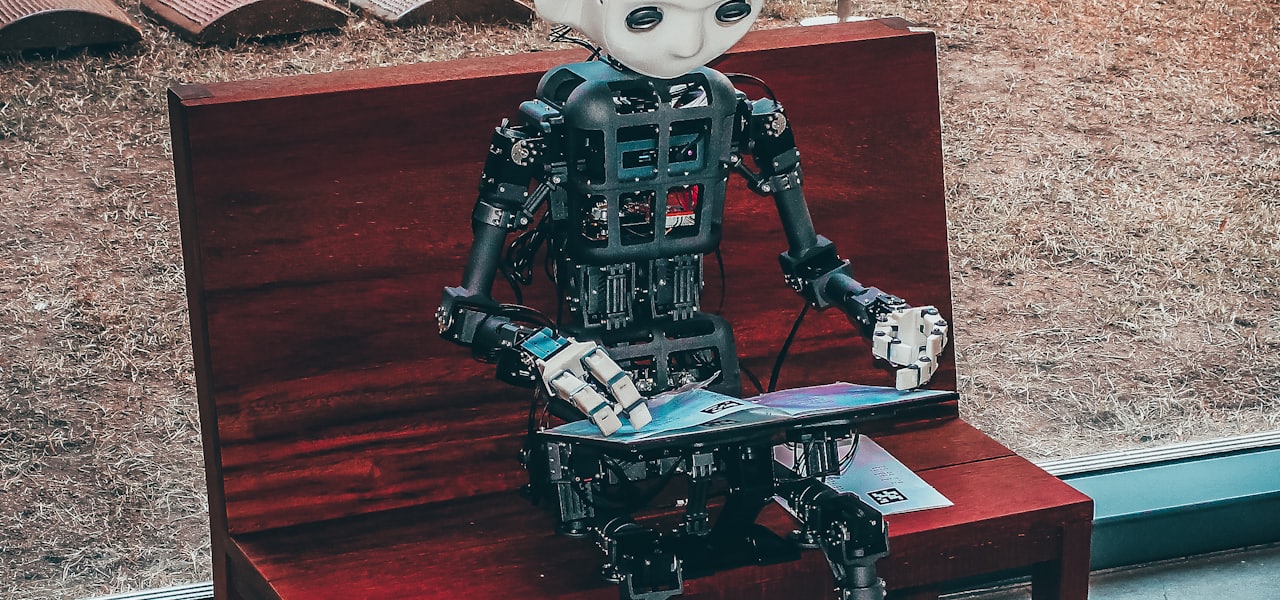
Robot learning is a research field at the intersection of machine learning and robotics. It studies techniques allowing a robot to acquire novel skills or adapt to its environment through learning algorithms. The embodiment of the robot, situated in a physical embedding, provides at the same time specific difficulties (e.g. high-dimensionality, real time constraints for collecting data and learning) and opportunities for guiding the learning process (e.g. sensorimotor synergies, motor primitives). Example of skills that are targeted by learning algorithms include sensorimotor skills such as locomotion, grasping, active object categorization, as well as interactive skills such as joint manipulation of an object with a human peer, and linguistic skills such as the grounded and situated meaning of human language. Learning can happen either through autonomous self-exploration or through guidance from a human teacher, like for example in robot learning by imitation. Robot learning can be closely related to adaptive control, reinforcement learning as well as developmental robotics which considers the problem of autonomous lifelong acquisition of repertoires of skills. While machine learning is frequently used by computer vision algorithms employed in the context of robotics, these applications are usually not referred to as "robot learning". == Imitation learning == Many research groups are developing techniques where robots learn by imitating. This includes various techniques for learning from demonstration (sometimes also referred to as "programming by demonstration") and observational learning. == Sharing learned skills and knowledge == In Tellex's "Million Object Challenge", the goal is robots that learn how to spot and handle simple items and upload their data to the cloud to allow other robots to analyze and use the information. RoboBrain is a knowledge engine for robots which can be freely accessed by any device wishing to carry out a task. The database gathers new information about tasks as robots perform them, by searching the Internet, interpreting natural language text, images, and videos, object recognition as well as interaction. The project is led by Ashutosh Saxena at Stanford University. RoboEarth is a project that has been described as a "World Wide Web for robots" − it is a network and database repository where robots can share information and learn from each other and a cloud for outsourcing heavy computation tasks. The project brings together researchers from five major universities in Germany, the Netherlands and Spain and is backed by the European Union. Google Research, DeepMind, and Google X have decided to allow their robots share their experiences. == Vision-language-action model == Research groups and companies are developing vision-language-action models, foundation models that allow robotic control through the combination of vision and language. Google DeepMind, Figure AI and Hugging Face are actively working on that.
Euratlas
Euratlas is a Switzerland-based software company dedicated to elaborate digital history maps of Europe. Founded in 2001, Euratlas has created a collection of history maps of Europe from year 1 AD to year 2000 AD that present the evolution of every country from the Roman Empire to present times. The evolution includes sovereign states and their administrative subdivisions, but also unorganized peoples and dependent territories. The maps show European country borders at regular intervals of 100 years, but not year by year. This leaves out many important turning points in history. Euratlas is considered a digital humanities company, and a scholar research software used in the field of historic cartography. It is broadly known among American and European universities, who mainly use Euratlas as a research tool and as a digital library atlas. == Sequential mapping policy == This concept was first designed by the German scholar Christian Kruse (1753–1827). Kruse, well aware that historical accounts are often biased for geographical, philosophical or political reasons, created a set of sequential maps in order to give a global vision of the successive political situations. Nowadays, the majority of atlases don't use this approach, but are event-based, like the well-known Penguin Atlas of History. The sequential approach intends to make the sequence of maps more neutral and suitable for students, historians and professionals of several fields. Although, this approach has been discussed as it leaves out many important history events that are not reflected on any of the maps because of the century interval. == Geo-referenced historical data == Initially, the European maps by century were developed as vector maps. From 2006 on, they have been converted to a geographic information system (GIS) database, enabling geo-referenced data capabilities. The map information is distributed in several layers: physical (geography information layer); political information layer (supranational entities, sovereign states, administrative divisions, dependent states and autonomous peoples); and special layers for cities and uncertain borders. The software database also contains much non-geographical information about political relationships between the various kinds of territories. == Map projection == Euratlas History Maps uses a Mercator projection, with the center in Europe. The maps include the North-African coast and the Near-East, offering a complete view of the Mediterranean Basin. The European Russia plains are shown, but not Scandinavia, specially Finland, which is cropped off the map view.
STIT logic
STIT logic (from seeing to it that) is a family of modal and branching-time logics for reasoning about agency and choice. A typical STIT operator has the form [ i s t i t : φ ] {\displaystyle [i\ {\mathsf {stit}}:\varphi ]} , usually read as "agent i {\displaystyle i} sees to it that φ {\displaystyle \varphi } ", and is interpreted in models where agents choose between alternative possible futures. STIT logics are used in action theory, deontic logic, epistemic logic, and the theory of intelligent agents to formalise notions such as "could have done otherwise", responsibility, joint action, and strategic ability in an indeterministic world. == Etymology == The acronym STIT comes from the English phrase "seeing to it that", introduced in influential work by Nuel Belnap and Michael Perloff on the logical analysis of agentive expressions. In this tradition, "to see to it that φ {\displaystyle \varphi } " is treated as a primitive agency operator, rather than being reduced to ordinary modal necessity. == History == Modern STIT logic arose in the 1980s in the context of branching-time semantics and formal theories of agency. Belnap and Perloff's article "Seeing to it that: A canonical form for agentives" introduced the idea of treating expressions of the form "agent i sees to it that φ" as a primitive modal operator, and analysed such sentences using a branching tree of moments and histories. This approach was further developed in a series of papers on indeterminism and agency and provided the conceptual core for later STIT formalisms. In the 1990s the basic formal systems of STIT logic were worked out. Horty and Belnap's influential paper on the deliberative STIT operator distinguished between a "Chellas" STIT that merely records the result of an agent's present choice and a "deliberative" STIT that requires the agent's choice to make a difference, and connected STIT with issues of action, omission, ability and obligation. Around the same time, Ming Xu proved completeness and decidability results for basic STIT systems, including a single-agent logic with Kripke-style semantics and axiomatizations for multi-agent deliberative STIT, thereby establishing STIT as a well-behaved normal modal framework. This early work was systematised in Belnap, Perloff and Xu's monograph Facing the Future: Agents and Choices in Our Indeterminist World, which presents a general branching-time semantics for individual and group STIT operators, discusses independence-of-agents conditions and articulates the metaphysical picture of an indeterministic "tree" of moments. At roughly the same time, Horty's book Agency and Deontic Logic developed deontic STIT logics in which obligations are tied to agents' available choices rather than to static states of affairs, and used the resulting systems to analyse "ought implies can", contrary-to-duty obligations and deontic paradoxes. These works helped to position STIT at the intersection of action theory, temporal logic and deontic logic. From the late 1990s and 2000s onward, STIT logics were combined with epistemic, temporal and strategic modalities. Broersen introduced complete STIT logics for knowledge and action and deontic-epistemic STIT systems that distinguish different modes of mens rea, with applications to responsibility and the specification of multi-agent systems. Work on group and coalitional agency investigated axiomatisations and complexity results for group STIT logics, and related STIT-based analyses of agency to coalition logic and alternating-time temporal logic (ATL) by exhibiting formal embeddings between the frameworks. Explicit temporal operators were added to STIT in so-called temporal STIT logics. Lorini proposed a temporal STIT with "next" and "until" operators along histories and showed how it can be applied to normative reasoning about ongoing behaviour and commitments. Ciuni and Lorini compared different semantics for temporal STIT, clarifying the relationships between branching-time, game-based and epistemic approaches, while Boudou and Lorini gave a semantics for temporal STIT based on concurrent game structures, thus strengthening links with standard models of multi-agent interaction used for ATL and strategy logic. In parallel, complexity-theoretic work by Balbiani, Herzig and Troquard and by Schwarzentruber and co-authors investigated the satisfiability and model-checking problems for various STIT fragments, showing for instance that many expressive group STIT logics are undecidable or of high computational complexity. In the 2010s, STIT ideas were combined with justification logic, imagination operators and refined deontic notions. Justification STIT logics, developed by Olkhovikov and others, merge explicit justifications with STIT-style agency so that producing a proof can itself be treated as an action that brings about knowledge, and they come with completeness and decidability results. Olkhovikov and Wansing introduced STIT imagination logics, together with axiomatic systems and tableau calculi, to model acts of voluntary imagining and their role in doxastic control. Other authors have proposed STIT-based logics of responsibility, blameworthiness and intentionality for use in philosophical and AI settings. Xu's survey article "Combinations of STIT with Ought and Know" (2015) reviews many of these developments and emphasises the interplay between deontic and epistemic STIT logics. Current research on STIT focuses on proof theory, automated reasoning and richer expressive resources. Lyon and van Berkel, building on earlier work on labelled calculi for STIT, have developed cut-free sequent systems and proof-search algorithms that yield syntactic decision procedures for a range of deontic and non-deontic multi-agent STIT logics and support applications such as duty checking and compliance checking in autonomous systems. Sawasaki has proposed first-order cstit-based STIT logics that can distinguish de re and de dicto readings of agency statements and has proved strong completeness results for Hilbert systems over finite models, moving the STIT programme beyond the purely propositional level. Further work investigates interpreted-system and computationally grounded semantics for STIT and its extensions in order to model the behaviour of autonomous agents in multi-agent settings, and proposes STIT-based semantics for epistemic notions based on patterns of information disclosure in interactive systems. == Branching-time semantics == STIT logics are usually interpreted over branching-time models. A standard STIT frame consists of: a non-empty set of moments T {\displaystyle T} , partially ordered by < {\displaystyle <} so that ( T , < ) {\displaystyle (T,<)} forms a tree (every pair of moments with a common predecessor has a greatest lower bound); a set of histories, each history being a maximal linearly ordered subset of T {\displaystyle T} ; a non-empty set of agents A g {\displaystyle Ag} ; for each agent i ∈ A g {\displaystyle i\in Ag} and moment m {\displaystyle m} , a choice function c h o i c e i m {\displaystyle {\mathsf {choice}}_{i}^{m}} that partitions the set of histories passing through m {\displaystyle m} into choice cells. The idea is that a moment represents a time at which choices are made, and histories represent complete possible future courses of events. At each moment, each agent's choice corresponds to selecting one of the available cells of histories determined by their choice function. Formulas are evaluated at pairs ( m , h ) {\displaystyle (m,h)} of a moment and a history through that moment (sometimes written m / h {\displaystyle m/h} ). A valuation assigns truth-values to atomic propositions at such indices; Boolean connectives are interpreted pointwise as in Kripke-style modal logic. == Chellas and deliberative STIT operators == Several STIT operators have been distinguished in the literature. A common approach uses two closely related operators, often called Chellas STIT and deliberative STIT. Let H m {\displaystyle H_{m}} be the set of histories passing through a moment m {\displaystyle m} , and write H m {\displaystyle H_{m}} ⟦ φ ⟧ m = { h ∈ H m ∣ M , m / h ⊨ φ } {\displaystyle {\text{⟦}}\varphi {\text{⟧}}_{m}=\{h\in H_{m}\mid M,m/h\models \varphi \}} for the set of histories at m {\displaystyle m} where φ {\displaystyle \varphi } holds. The Chellas STIT operator, often written [ i c s t i t : φ ] {\displaystyle [i\ {\mathsf {cstit}}:\varphi ]} , is given by M , m / h ⊨ [ i c s t i t : φ ] iff c h o i c e i m ( h ) ⊆ ⟦ φ ⟧ m . {\displaystyle M,m/h\models [i\ {\mathsf {cstit}}:\varphi ]\quad {\text{iff}}\quad {\mathsf {choice}}_{i}^{m}(h)\subseteq {\text{⟦}}\varphi {\text{⟧}}_{m}.} Intuitively, agent i {\displaystyle i} sees to it that φ {\displaystyle \varphi } if φ {\displaystyle \varphi } holds at all histories compatible with their present choice. The deliberative STIT operator, [ i d s t i t : φ ] {\displaystyle [i\ {\mathsf {dstit}}:\varphi ]} , adds